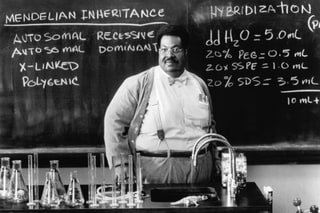
The 1996 version of The Nutty Professor is a curious remake by comedian Eddie Murphy of one of Jerry Lewis's best films (1963), in which Lewis played a scientist, Julius Kelp, packed with cinematic clichés.
Kelp is a brilliant chemistry professor, but a social misfit: he has no luck with girls, he cannot keep up with the currents that shaped the unforgettable youth of the early sixties, and he decides to use science to change his personality and break through the wall of social exclusion he finds unbearable.
To do so, Lewis draws on Stevenson's great work, Dr. Jekyll and Mr. Hyde. A potion brings about the changes he needs to become a ladies' man who makes a dazzling entrance into society under the nickname Buddy Love.
But the solution, which works very well at first, begins to wear off, and the story heads for disaster...
We watch the two personalities – the clumsy professor and the handsome charmer – struggle to surface at the most inopportune moments. The trouble comes when Buddy gives way to the scientist at the critical moments. Chemistry is telling Lewis that his potion is a patch, that he must accept himself in front of everyone, and that in fact the idea of permanently becoming Buddy – an attractive but far too narcissistic character – is a pipe dream.

In Lewis's film, science comes to the rescue of the nutty scientist to bring him back – albeit misguidedly – into the fold of what is acceptable. The film was shot in 1963. There are no obese characters in it. Hence the curious twist in the story that Eddie Murphy, filming more than three decades later, chose for his remake.
Sherman Klump is a hugely obese character, and it is precisely because of his enormous weight that the professor cannot have the social life he wants. So he turns to science to shed all those extra pounds miraculously and become an Eddie Murphy as narcissistic as he is insufferable (in the eyes of the audience).
Cinema is a mirror of society and its changes. In those reflections we can glimpse some extraordinarily interesting things. Although there have always been fat actors, the truth is that obesity began to appear more often on screen in the nineties. Why?
Obesity statistics in the United States showed that between 1960 and 1962, 10.7 percent of people aged 24 to 70 were obese. By 1988 that percentage had doubled. And in 1999 it reached 27.2 percent. Since 2010, the proportion of obese Americans has come close to 36 percent (see chart).

And Spain? We have seen a similar increase, though on a smaller scale. Today one in six Spaniards is obese, two in three men are overweight, and the same is true of one in three children aged 13 to 14.
Why is this happening?
It is not an easy question to answer, and I confess the matter has been on my mind for a long time.
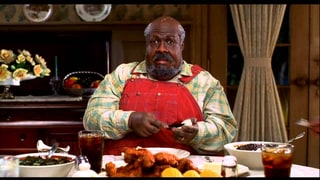
In one of the best scenes of Murphy's Nutty Professor, Sherman invites his girlfriend to a family dinner. The diners are all fat; they wolf down enormous quantities of food while cracking all sorts of crude jokes. It is an exaggeration, but Murphy is telling us that people are getting fatter because they exercise less but, above all, because they eat much more.
All right, but why do we eat much more now than we used to?
I have always thought that science can give us an answer. Especially in light of new brain studies showing the effects that most processed foods – which have taken over the supermarkets – have on the brain.
If you want my honest opinion, I believe much of the obesity in many parts of the world, and especially in the United States, is due to the lucrative business of the scientific design of food carried out by the big multinationals; foods that ultimately produce a kind of eating that is addictive for consumers.
Does that sound exaggerated? For decades, tobacco companies denied that smoking causes cancer while at the same time adding ingredients to cigarettes that made them more addictive.
Like tobacco, many of these foods create a craving in our brains that a single bite cannot satisfy. We have to eat much more. And as we do, we speed up the cash registers of the big corporations that dominate the world food market, whose sales and profits keep rising year after year.
Michael Moss, a reporter at The New York Times and author of a book called Salt Sugar Fat: How the Food Giants Hooked Us, has written a magnificent, thoroughly documented story about what he calls “the extraordinary science of addictive junk food”, after years of investigation.

Moss has won a Pulitzer, so he is a far better journalist than I am. But above all, he has thoroughly examined hundreds of documents handled by these transnational food companies. And what emerges from that research is hair-raising.
Think how tasty hamburgers are, how tempting Coca-Cola is, the snacks, the potato chips, the sweetened yogurts, the ready-made desserts, the sweet corn, the pre-packaged breakfasts for children, the ready meals, the vast range of pasta sauces, the flavored margarines and butters, the frozen pizzas, the many kinds of mayonnaise, the factory-made ice creams and a very long list of other foods we can find in any supermarket.
Consider that each of them is the result of scientific studies and research that determine which ingredients must be mixed or added to intensify the flavor and make it more appealing: textures, aromas, mouthfeel, how they melt in the mouth, firmness, whether they are crunchy enough... a legion of scientists and experts work for these big corporations, which are constantly looking for ways to increase their sales.
Moss has published a magnificent article in The New York Times, based on his book, showing that the main concern of the food industry in the United States (at least during the nineties) has not been nutrition: it is taste.
If one thing tastes better than another, it will sell more.
In the course of his research, Moss asked one of the senior executives at Oscar Mayer about the high salt, sugar and fat content of the pre-packaged meals for children (called Lunchables in the United States). The answer went like this: “This is what the consumer wants, and we're not putting a gun to their head to eat it. That's what they want. If we give them less, they'll buy less, and the competition will take our market.”
Moss, after four years of research, believes there is a “conscious effort” on the part of these food multinationals to get people “hooked on foods that are convenient and inexpensive.”
The result of this ongoing addiction, despite health and prevention programs, is a growing trend toward producing more and more obese and overweight people. By 2050, half of the American adult population is expected to be obese.
A simple potato chip is coated in salt and fat and contains sugar in its starch, which makes it the perfect addictive food, explains Eric Rimm, professor of epidemiology and nutrition at Harvard Medical School, in Moss's article. The potato chip sends blood glucose levels soaring and prompts the brain to want more.
We are surrounded by foods that will clearly make us obese. And obesity is linked to cancer, diabetes and cardiovascular disease. The percentage of adults and teenagers with early-onset diabetes is skyrocketing. And the cost of these treatments to the health system is astronomical.
Tobacco companies in the United States spend more than 10 billion dollars a year promoting their cigarettes in shops, gas stations and other outlets, placing their brands next to shelves of ice cream, toys, chewing gum and children's products.
But as Kelly Brownell, professor of psychology and public health at Yale University, told this excellent journalist, “we get upset with the tobacco companies for this kind of advertising aimed at teenagers, but we step aside when the food companies do the same.” In his view, the bill that poor diets now leave for the health system rivals the one left by the tobacco companies.